Snake Eyes is an experimental, interactive, viewer-generated two-channel ASCII video artwork. The core of the installation is a custom mechanical interface driven by a double pendulum, translating a two-encoder position data stream into a signal used by a custom ASCII video generator. The title, Snake Eyes, comes from the idea of a lucky or unlucky dice roll—when the pendulum’s two arms align—triggering a spontaneous deterioration in the ASCII vector field. While subtle, the concept relates to bit rot in media materials, where information decays over time in stored memory systems.
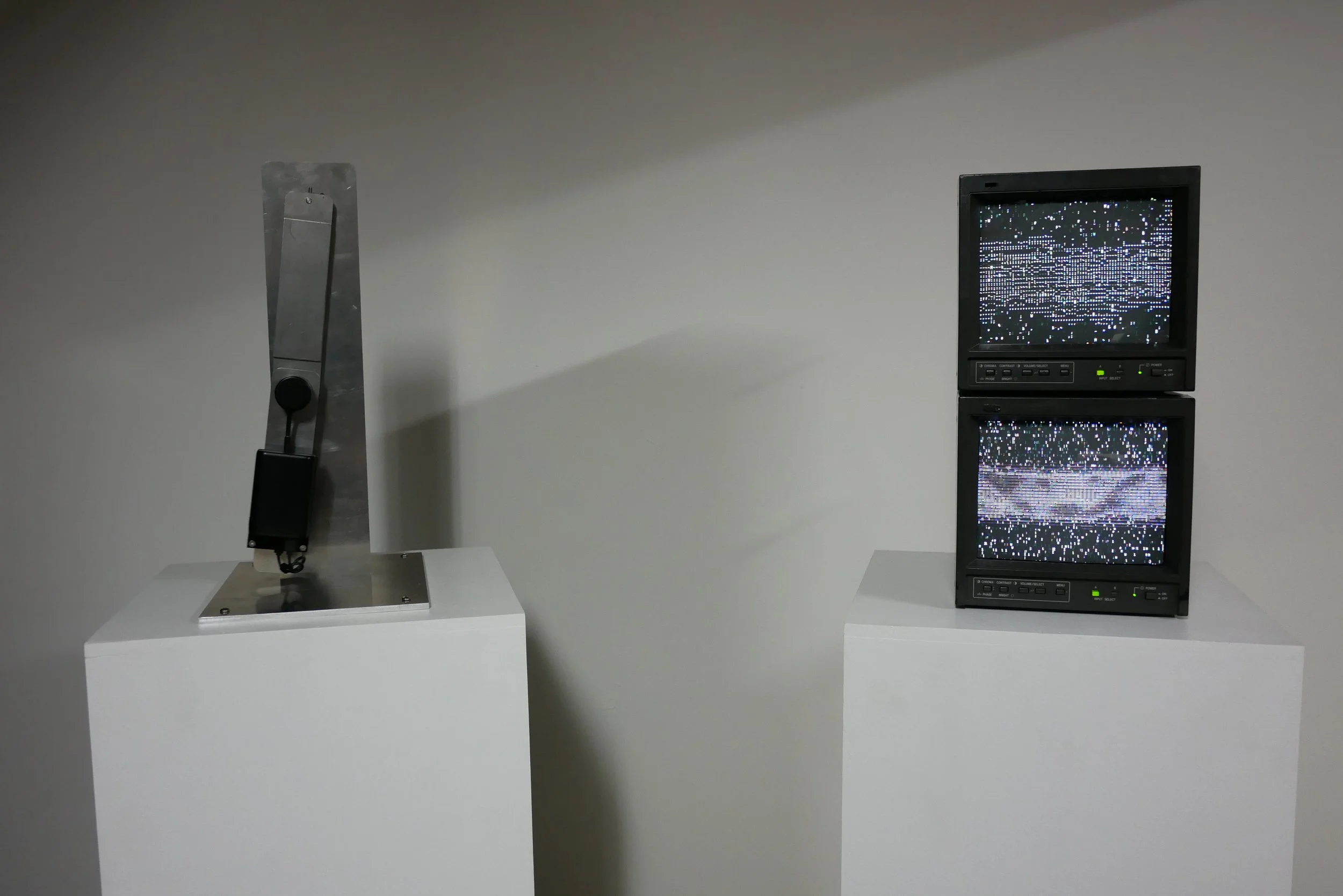
Snake Eyes, 2026 Installation view, double pendulum with dual CRT displays
A double pendulum acts as a continuous signal source, its motion measured at two joints and transmitted to a pair of CRT displays. Each screen constructs a dense field of ASCII characters animated by the shared data stream. Oscillatory motion produces rippling disturbances across an otherwise stable surface.
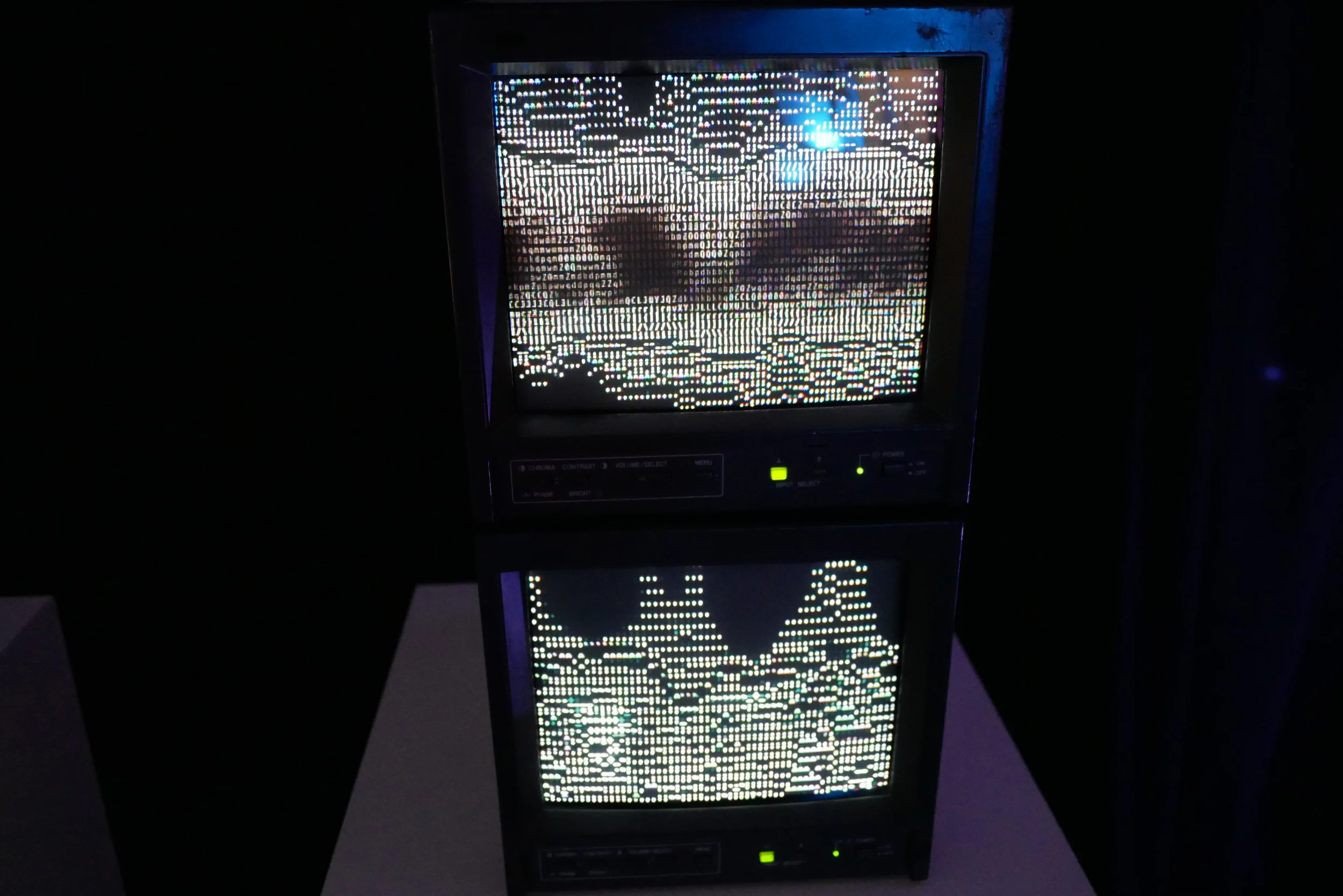
Snake Eyes, 2026 Dual CRT detail, ASCII field under oscillatory disturbance
Moments of agreement generate brief intensifications—“lucky” alignments—while divergence introduces turbulence, washing out the image. Though both displays are driven by the same system, they drift in and out of sync as separate interpretations.
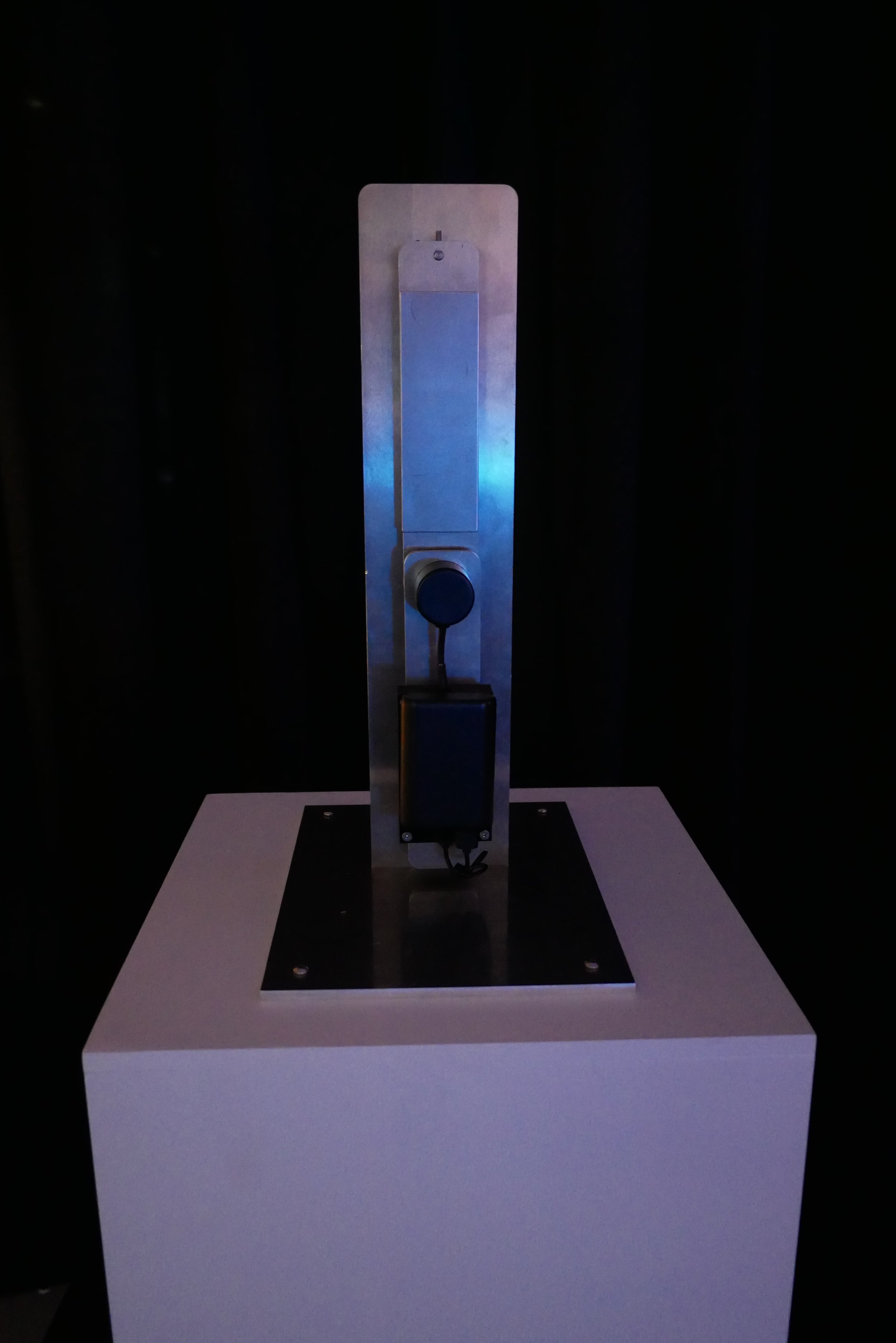
Pendulonium, 2026, Custom dual-encoder mechanical interface
Pendulonium (2026) is a custom-designed mechanical interface developed to translate physical oscillation into real-time audiovisual behavior. The system uses paired pendulums with encoded joints to generate continuous data streams, which are mapped to distinct parameters of a distributed audio or visual field. Designed as both instrument and system, Pendulonium enables direct physical interaction with chaotic motion, producing sound and images that emerge through the interplay of control and turbulent dynamics.